---
title: Reducing System Footprint with Silicon Carbide Modules
description: Explore how silicon carbide (SiC) modules improve high-power design with higher efficiency, reduced footprint, and enhanced thermal performance.
image: https://blog.apexanalog.com/hubfs/MSA303%20on%20Board.jpg
---
[](https://www.apexanalog.com/)
- [Home](https://www.apexanalog.com/)
- Products
- - POWER OPERATIONAL AMPLIFIERS
- [High Current Product Selector Matrix](https://www.apexanalog.com/products/matrix_high-current.html)
- [High Voltage Product Selector Matrix](https://www.apexanalog.com/products/matrix_high-voltage.html)
- [Product Selector Tables](https://www.apexanalog.com/products/linear_selector.html)
- PWM AMPLIFIERS
- [PWM Selector Matrix](https://www.apexanalog.com/products/matrix_pwm.html)
- [Product Selector Tables](https://www.apexanalog.com/products/pwm_selector.html)
- VOLTAGE REFERENCES
- [VRE Selector Matrix](https://www.apexanalog.com/products/matrix_vre.html)
- [VRE Over Temp Selector](https://www.apexanalog.com/products/vre_over-temperature.html)
- [Product Selector Tables](https://www.apexanalog.com/products/vre_selector.html)
- ACCESSORIES
- [Evaluation Kits](https://www.apexanalog.com/products/accessories.html#evaluationKits)
- [Heat Sinks](https://www.apexanalog.com/products/accessories.html#heatsinks)
- [Mating Sockets](https://www.apexanalog.com/products/accessories.html#matingSockets)
- [Thermal Washers](https://www.apexanalog.com/products/accessories.html#thermalWashers)
- [Applications](https://www.apexanalog.com/applications/applications_overview.html)
- [Overview](https://www.apexanalog.com/applications/applications_overview.html)
- [Defense/Aerospace](https://www.apexanalog.com/applications/defense-aerospace.html)
- [Industrial](https://www.apexanalog.com/applications/industrial.html)
- [Medical](https://www.apexanalog.com/applications/medical.html)
- [Semi-Cap](https://www.apexanalog.com/applications/semi-cap.html)
- [Digital Printing](https://www.apexanalog.com/applications/ink-jet-printer.html)
- Support
- [Contact Technical Support](https://www.apexanalog.com/support/technical_support.html)
- [Failure Analysis Request](https://www.apexanalog.com/support/failure_analysis_request.html)
- [Request Lunch and Learn](https://www.apexanalog.com/support/lunch_and_learn.html)
- Design Resources
- [Power Design Software Tool](https://www.apexanalog.com/support/power_design_tool.html)
- [Product Selection Guide](https://www.apexanalog.com/resources/productbulletins/Product-Selection-Guide.pdf?__hstc=139971436.19e8af8d486e9d2b866a3feaa060a1e9.1639456649422.1639456649422.1639456649422.1&__hssc=139971436.26.1639456649423&__hsfp=3512255926)
- [Aerospace/Defense Solutions Guide](https://www.apexanalog.com/resources/productbulletins/Defense-and-Aerospace-Solutions-Guide.PDF?__hstc=139971436.19e8af8d486e9d2b866a3feaa060a1e9.1639456649422.1639456649422.1639456649422.1&__hssc=139971436.26.1639456649423&__hsfp=3512255926)
- [Application Note Library](https://www.apexanalog.com/support/app_note_library.html)
- [Technical Seminar Library](https://www.apexanalog.com/support/tech_seminar_library.html)
- [Technical Article Library](https://www.apexanalog.com/support/tech_article_library.html)
- [Spice Models](https://www.apexanalog.com/support/spice_models.html)
- [Literature](https://www.apexanalog.com/support/literature.html)
- [Request a Lunch & Learn](https://www.apexanalog.com/support/lunch_and_learn.html)
- Sales
- [Contact Technical Support](https://www.apexanalog.com/support/technical_support.html)
- [Contact Sales/Customer Service](https://www.apexanalog.com/sales/contact_us.html)
- [Request a Quote](https://www.apexanalog.com/sales/quote_request.html)
- [Request a Sample](https://www.apexanalog.com/sales/sample_request.html)
- [Distributors and Sales Representatives](https://www.apexanalog.com/company/apex_sales.html)
- Quality
- [Apex Certifications](https://www.apexanalog.com/quality/apex_certifications.html)
- [Military Product Grades and Screening Program](https://www.apexanalog.com/quality/mil_product_grades_screening_program.html)
- [Product Marking](https://www.apexanalog.com/quality/product_marking.html)
- [Product Reliability Predictions](https://www.apexanalog.com/quality/product_reliability_predictions.html)
- [Product/Process Changes Notices (PCNs)](https://www.apexanalog.com/quality/product_change_notices.html)
- [Counterfeit Product Policy](https://www.apexanalog.com/quality/counterfeit_product_policy.html)
- [Date Code Policy](https://www.apexanalog.com/quality/date_code_policy.html)
- [Conflict Minerals](https://www.apexanalog.com/quality/conflict_materials.html)
- [Materials Database](https://www.apexanalog.com/quality/materials_database.html)
- [RoHS Compliance](https://www.apexanalog.com/quality/rohs_compliance.html)
- [REACH/SVHC](https://www.apexanalog.com/quality/reach_svhc.html)
- Company
- [Press Releases](https://www.apexanalog.com/company/press-releases.html)
- [Careers at Apex Microtechnology](https://www.apexanalog.com/company/careers.html)
- [Suppliers](https://www.apexanalog.com/company/suppliers.html)
- [Leadership](https://www.apexanalog.com/company/leadership.html)
- [About Apex Microtechnology](https://www.apexanalog.com/company/about.html)
- [Events](https://www.apexanalog.com/company/events.html)
- [Blog](https://blog.apexanalog.com/?__hstc=139971436.19e8af8d486e9d2b866a3feaa060a1e9.1639456649422.1639717738576.1639722129361.13&__hssc=139971436.5.1639722129361&__hsfp=3379298706)
-
-
-
-
- [Home](https://www.apexanalog.com/)
- Products
- - POWER OPERATIONAL AMPLIFIERS
- [High Current Product Selector Matrix](https://www.apexanalog.com/products/matrix_high-current.html)
- [High Voltage Product Selector Matrix](https://www.apexanalog.com/products/matrix_high-voltage.html)
- [Product Selector Tables](https://www.apexanalog.com/products/linear_selector.html)
- PWM AMPLIFIERS
- [PWM Selector Matrix](https://www.apexanalog.com/products/matrix_pwm.html)
- [Product Selector Tables](https://www.apexanalog.com/products/pwm_selector.html)
- VOLTAGE REFERENCES
- [VRE Selector Matrix](https://www.apexanalog.com/products/matrix_vre.html)
- [VRE Over Temp Selector](https://www.apexanalog.com/products/vre_over-temperature.html)
- [Product Selector Tables](https://www.apexanalog.com/products/vre_selector.html)
- ACCESSORIES
- [Evaluation Kits](https://www.apexanalog.com/products/accessories.html#evaluationKits)
- [Heat Sinks](https://www.apexanalog.com/products/accessories.html#heatsinks)
- [Mating Sockets](https://www.apexanalog.com/products/accessories.html#matingSockets)
- [Thermal Washers](https://www.apexanalog.com/products/accessories.html#thermalWashers)
- [Applications](https://www.apexanalog.com/applications/applications_overview.html)
- [Overview](https://www.apexanalog.com/applications/applications_overview.html)
- [Defense/Aerospace](https://www.apexanalog.com/applications/defense-aerospace.html)
- [Industrial](https://www.apexanalog.com/applications/industrial.html)
- [Medical](https://www.apexanalog.com/applications/medical.html)
- [Semi-Cap](https://www.apexanalog.com/applications/semi-cap.html)
- [Digital Printing](https://www.apexanalog.com/applications/ink-jet-printer.html)
- Support
- [Contact Technical Support](https://www.apexanalog.com/support/technical_support.html)
- [Failure Analysis Request](https://www.apexanalog.com/support/failure_analysis_request.html)
- [Request Lunch and Learn](https://www.apexanalog.com/support/lunch_and_learn.html)
- Design Resources
- [Power Design Software Tool](https://www.apexanalog.com/support/power_design_tool.html)
- [Product Selection Guide](https://www.apexanalog.com/resources/productbulletins/Product-Selection-Guide.pdf?__hstc=139971436.19e8af8d486e9d2b866a3feaa060a1e9.1639456649422.1639456649422.1639456649422.1&__hssc=139971436.26.1639456649423&__hsfp=3512255926)
- [Aerospace/Defense Solutions Guide](https://www.apexanalog.com/resources/productbulletins/Defense-and-Aerospace-Solutions-Guide.PDF?__hstc=139971436.19e8af8d486e9d2b866a3feaa060a1e9.1639456649422.1639456649422.1639456649422.1&__hssc=139971436.26.1639456649423&__hsfp=3512255926)
- [Application Note Library](https://www.apexanalog.com/support/app_note_library.html)
- [Technical Seminar Library](https://www.apexanalog.com/support/tech_seminar_library.html)
- [Technical Article Library](https://www.apexanalog.com/support/tech_article_library.html)
- [Spice Models](https://www.apexanalog.com/support/spice_models.html)
- [Literature](https://www.apexanalog.com/support/literature.html)
- [Request a Lunch & Learn](https://www.apexanalog.com/support/lunch_and_learn.html)
- Sales
- [Contact Technical Support](https://www.apexanalog.com/support/technical_support.html)
- [Contact Sales/Customer Service](https://www.apexanalog.com/sales/contact_us.html)
- [Request a Quote](https://www.apexanalog.com/sales/quote_request.html)
- [Request a Sample](https://www.apexanalog.com/sales/sample_request.html)
- [Distributors and Sales Representatives](https://www.apexanalog.com/company/apex_sales.html)
- Quality
- [Apex Certifications](https://www.apexanalog.com/quality/apex_certifications.html)
- [Military Product Grades and Screening Program](https://www.apexanalog.com/quality/mil_product_grades_screening_program.html)
- [Product Marking](https://www.apexanalog.com/quality/product_marking.html)
- [Product Reliability Predictions](https://www.apexanalog.com/quality/product_reliability_predictions.html)
- [Product/Process Changes Notices (PCNs)](https://www.apexanalog.com/quality/product_change_notices.html)
- [Counterfeit Product Policy](https://www.apexanalog.com/quality/counterfeit_product_policy.html)
- [Date Code Policy](https://www.apexanalog.com/quality/date_code_policy.html)
- [Conflict Minerals](https://www.apexanalog.com/quality/conflict_materials.html)
- [Materials Database](https://www.apexanalog.com/quality/materials_database.html)
- [RoHS Compliance](https://www.apexanalog.com/quality/rohs_compliance.html)
- [REACH/SVHC](https://www.apexanalog.com/quality/reach_svhc.html)
- Company
- [Press Releases](https://www.apexanalog.com/company/press-releases.html)
- [Careers at Apex Microtechnology](https://www.apexanalog.com/company/careers.html)
- [Suppliers](https://www.apexanalog.com/company/suppliers.html)
- [Leadership](https://www.apexanalog.com/company/leadership.html)
- [About Apex Microtechnology](https://www.apexanalog.com/company/about.html)
- [Events](https://www.apexanalog.com/company/events.html)
- [Blog](https://blog.apexanalog.com/?__hstc=139971436.19e8af8d486e9d2b866a3feaa060a1e9.1639456649422.1639717738576.1639722129361.13&__hssc=139971436.5.1639722129361&__hsfp=3379298706)
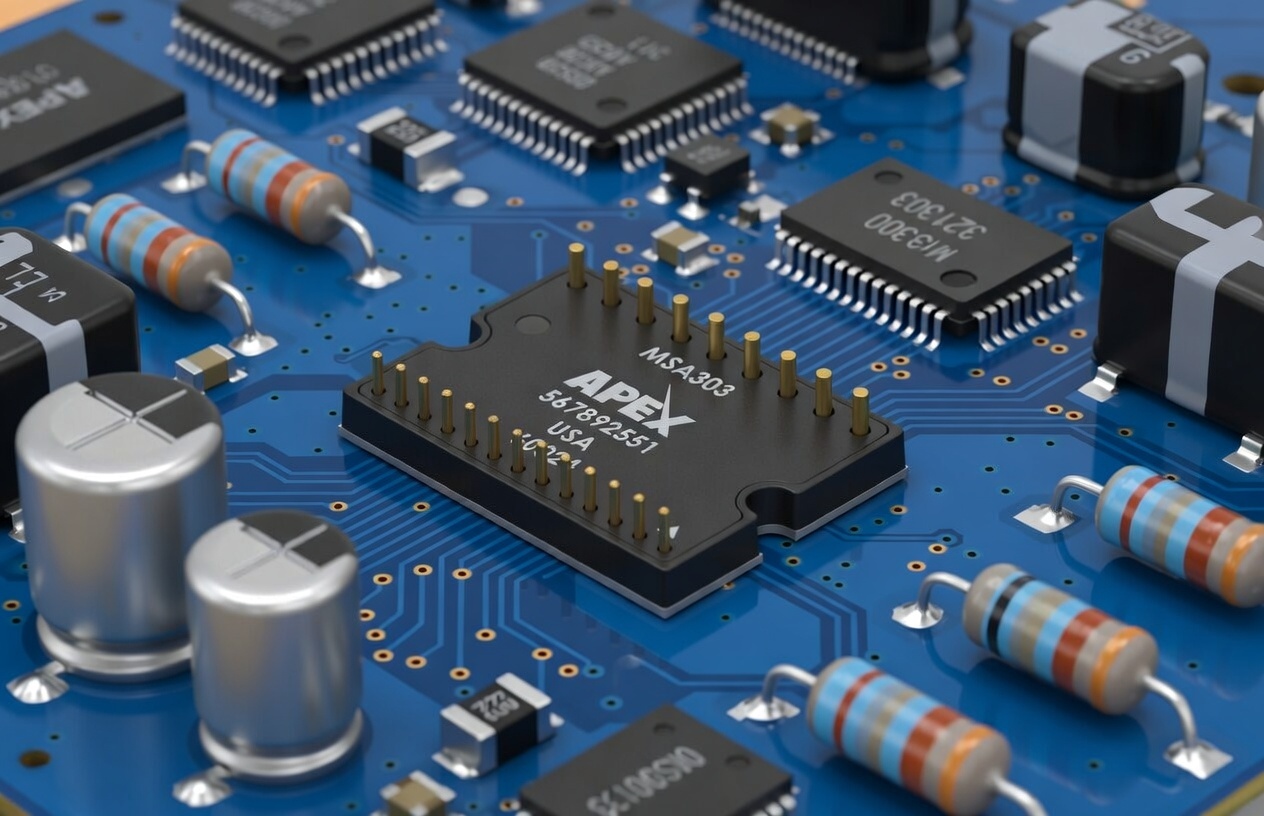
# Reducing System Footprint with Silicon Carbide Modules
Published by [Apex Microtechnology](https://blog.apexanalog.com/author/apex-microtechnology) on Mar 30, 2026, 2:39:01 PM
As high-power systems demand greater efficiency in smaller footprints, Silicon Carbide Integrated Power Modules provide a path to improved performance, reduced complexity, and increased reliability across demanding applications.
As power system architecture continues to evolve, designers are being asked to maintain or deliver higher performance within increasingly size-constrained systems. Across industries including industrial, medical, and aerospace & defense, there is growing pressure to achieve greater efficiency, higher power density, and increased product reliability, all while continuing to reduce overall system size. These competing demands are often requested in tandem, requiring design engineers to balance trade-offs associated with improved electrical performance, enhanced thermal behavior, and minimized physical layout simultaneously rather than focusing on each challenge independently.
Thermal performance remains a limiting factor in high-power systems. As power levels increase, thermal losses scale accordingly. These losses not only reduce efficiency, but also affect device behavior, accelerate material fatigue, and shorten operational lifetime. At the same time, shrinking system footprints concentrate thermal density, making heat removal more difficult. Designers must therefore manage total power as well as how consistently that power can be delivered across varying temperatures, load conditions, and operating environments.
Discrete design has traditionally been the standard approach for building high-power analog systems, offering flexibility in architecture and component selection. However, this flexibility comes at the cost of increased complexity. Each component must be selected, validated, and integrated into a layout that carefully manages electrical, thermal, and mechanical constraints. As switching speeds and power levels increase, parasitic effects begin to dominate system behavior. Stray inductance and capacitance introduced through PCB layout and interconnects can lead to voltage overshoot, ringing, and electromagnetic interference during high di/dt and dv/dt transitions. These effects not only reduce efficiency but also introduce additional stress on devices, impacting long-term reliability.
The effects mentioned create a fundamental trade-off in discrete systems. Faster switching improves efficiency but increases noise and transient stress, while slower switching reduces these effects at the cost of higher losses. Managing this balance often requires iterative tuning of gate resistances, snubber networks, and layout. Even then, performance can vary between implementations due to layout differences and component tolerances. The contrast becomes evident at the board level, where integrated module solutions can significantly reduce component count and occupied area compared to discrete designs, as illustrated in *Figure 1*.
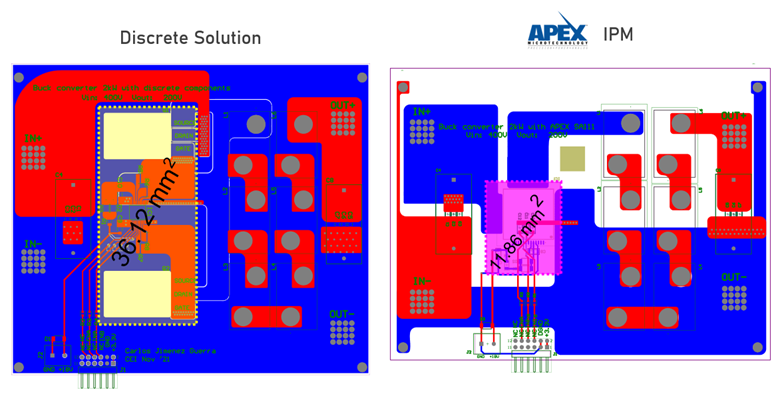
*Figure 1: Board size comparison between a discrete design and an Apex Integrated Power Module*
**From Discrete Complexity to Integrated Power Solutions**
Integrated power modules (IPMs) address many of these challenges by embedding critical functions within the device itself. Rather than relying on external circuitry to manage switching behavior, parasitics, and protection, these modules consolidate power devices, gate drive, and protection circuitry into a single, optimized package.
This type of integration delivers more than convenience by directly improving electrical performance. By minimizing interconnect lengths and tightly controlling internal layouts, integrated modules reduce loop inductance in critical switching paths. Resulting in more controlled switching transitions, reduced voltage overshoot, and less ringing under high-speed operation. These improvements are difficult to replicate consistently in discrete designs, where layout variability can significantly impact performance.
Integrated gate drive design is another area where IPMs provide a clear advantage. In discrete systems, gate drivers must be carefully matched to the characteristics of the power devices. Integrated modules eliminate this burden by ensuring these elements are complimentary within the package. This practice provides enhanced switching behavior, appropriate slew rates, and improved noise immunity which result in more predictable performance and reduce the likelihood of design-related issues during development.
Beyond electrical performance, integration also improves consistency. Discrete designs are sensitive to layout variations and component tolerances, which can lead to differences in performance between prototypes or production units. By embedding critical electrical paths within the package, integrated modules reduce this variability and provide more repeatable results. For engineers developing multiple systems or scaling production, this consistency can significantly reduce validation effort and overall design risk.
Why Silicon Carbide Changes the Design Equation
While integration addresses structural design challenges, silicon carbide (SiC) fundamentally improves device-level performance. As a wide-bandgap semiconductor, SiC supports higher electric fields and improved thermal conductivity, enabling devices with higher breakdown voltages and lower on-resistance compared to traditional silicon. These characteristics allow SiC devices to operate efficiently in high-voltage and high-current environments while maintaining stable performance.
The impact is most evident in switching performance. Lower on-resistance (RDS(ON)) reduces conduction losses, while faster switching reduces energy dissipated during turn-on and turn-off events. In many systems, switching losses, often defined by Eon and Eoff, represent a significant portion of total power dissipation. Reducing these losses allows for higher switching frequencies without a proportional increase in heat, enabling smaller passive components and more compact system designs.
These improvements are particularly evident when comparing integrated SiC modules to discrete implementations. In discrete systems, switching losses are heavily influenced by parasitic inductance, gate drive tuning, and layout-dependent effects. Variations in any of these factors can increase switching energy, reduce efficiency, and introduce additional thermal stress.
Integrated SiC modules mitigate these challenges by minimizing internal parasitics and optimizing switching behavior within the device. The result is faster, more controlled transitions with reduced energy loss during each switching cycle. This performance advantage is illustrated in *Figure 2*, where integrated power modules demonstrate lower switching losses compared to discrete designs. By reducing switching losses, designers can either improve overall system efficiency or operate at higher switching frequencies without increasing thermal burden.
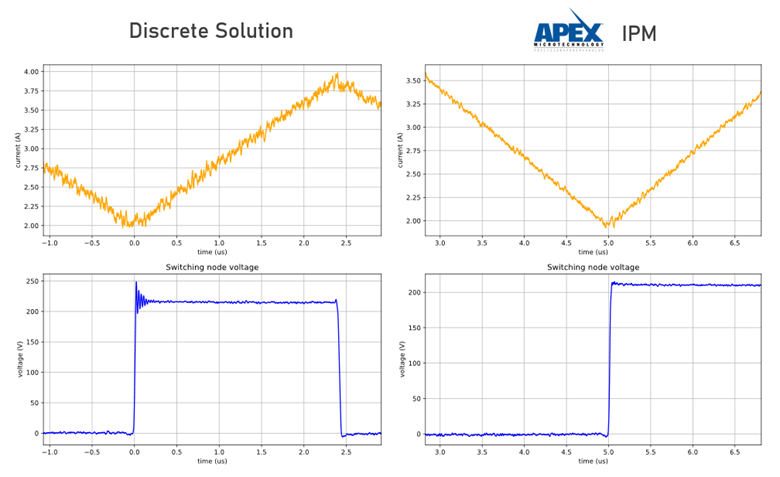
*Figure 2: Comparing switching losses of a discrete design to an Apex Integrated Power Module*
In addition to improving efficiency, SiC devices enable operation in more demanding thermal environments. With stable performance at junction temperatures exceeding 200°C, SiC provides greater design flexibility in applications where thermal conditions are difficult to control. This expanded operating range reduces the need for aggressive derating and allows systems to maintain performance under a wider range of conditions.
System-Level Benefits: Protection, Thermal Performance, and Scalability
When silicon carbide is combined with integrated module design, the benefits extend beyond individual components to the system as a whole. Reduced losses and improved switching behavior lower thermal stress, while integration reduces component count and simplifies layout. The result is a system that is not only smaller, but also more predictable and easier to design.
Protection is another area where integration delivers measurable improvements. In discrete designs, protection mechanisms such as overcurrent detection, thermal shutdown, and under-voltage lock-out are implemented externally, often introducing delays in sensing and response. Integrated power modules incorporate these protections directly within the package, enabling faster fault detection and response. Features such as desaturation monitoring and thermal protection can react with minimal latency, helping prevent catastrophic failures and reducing cumulative stress on the system during transient events such as startup, load changes, or fault conditions.
These transient conditions are often where reliability issues originate. While steady-state performance is typically well understood, repeated exposure to switching transients and fault events can degrade devices over time. By responding more quickly and consistently to these conditions, integrated modules help extend operational lifetime and improve overall system robustness.
The reduction in external components also has a direct impact on footprint and layout complexity. Fewer components mean shorter routing paths, reduced parasitic interactions, and simpler board designs. This is particularly important in applications with strict size, weight, and power (SWaP) constraints, where even small reductions in footprint can translate into meaningful system-level benefits.
Thermal performance remains central to reliability. Lower losses reduce heat generation, while integrated packaging improves heat conduction away from critical components. The result is lower operating temperatures, reduced thermal cycling, and less mechanical stress over time. These factors directly contribute to longer device lifetimes. Finally, integrated SiC modules support a more scalable design approach. Engineers can reuse proven solutions across multiple platforms, reducing development time and ensuring consistent performance. This repeatability is increasingly important in applications where certification, reliability, and time to market are critical.
Apex Microtechnology continues to advance this approach with its latest [silicon carbide integrated power module, the MSA303](https://www.apexanalog.com/products/msa303.html). Designed to deliver high-efficiency switching performance in a compact form factor, the MSA303 integrates key power and control functions into a single, robust solution, reducing the need for external components while simplifying system design. By combining optimized switching performance, integrated gate drive, and embedded protection features, the device enables engineers to achieve improved power density, enhanced reliability, and faster development cycles. As system requirements continue to evolve, solutions like the MSA303 demonstrate how integrated SiC modules are enabling the next generation of high-performance power electronics.
To view our full Integrated Power Module family, visit [Silicon Carbide IPM Product Table.](https://www.apexanalog.com/products/ipm-selector.html)
-Apex Microtechnology
Tags: [Integrated Power Modules](https://blog.apexanalog.com/tag/integrated-power-modules)
[Back to Blog](https://blog.apexanalog.com)
- [Tweet](https://twitter.com/share)
## Related Articles
## [Apex Releases New 3-Phase Silicon Carbide Integrated Power Module](https://blog.apexanalog.com/apex-msa303-release)
MSA303 delivers compact, high-efficiency motor drive performance with fully integrated gate drive...
[Read More](https://blog.apexanalog.com/apex-msa303-release)
## [New High-Voltage Op-amps Deliver Higher Current and Improved Thermal Performance](https://blog.apexanalog.com/pq-expansion)
Apex recently released the PA167, PA168, and PA169 which combine monolithic MOS technology,...
[Read More](https://blog.apexanalog.com/pq-expansion)
## [Apex Releases new 2000V/µs, 450V Power Amplifier in PowerSIP](https://blog.apexanalog.com/pa198)
Apex Microtechnology releases latest power operational amplifier, delivering high power with...
[Read More](https://blog.apexanalog.com/pa198)
##### Analog Tech Talk
#### Subscribe Now!
Register now to receive our monthly eNewsletter and expand your knowledge of power analog design — one topic at a time.

Apex Microtechnology (Apex) offers industry-leading power analog innovation for applications requiring high precision control of current, voltage and speed in the industrial, defense and aerospace, medical, and semiconductor capital equipment markets. The Apex product families include power operational amplifiers (linear amplifiers), PWM amplifiers (pulse width modulation, Class D amplifiers, switching amplifiers) and precision voltage references.
#### Company
- [About Apex](https://www.apexanalog.com/company/about.html)
- [Leadership](https://www.apexanalog.com/company/leadership.html)
- [Careers at Apex](https://www.apexanalog.com/company/careers.html)
- [Quality](https://www.apexanalog.com/quality/apex_certifications.html)
- [Sales and Distributors](https://www.apexanalog.com/company/apex_sales.html)
- [Suppliers](https://www.apexanalog.com/company/suppliers.html)
- [Contact](https://www.apexanalog.com/sales/contact_us.html)
- [Events](https://www.apexanalog.com/company/events.html)
- [Webmaster](https://www.apexanalog.com/company/webmaster.html)
- [SalesNet Login](https://apexanalog.sharepoint.com/sites/salesnet/SitePages/Home.aspx)
#### Literature
- [Data Book](https://cloud.3dissue.com/95932/96351/113449/Databook-Oct2015/index.html)
- [Product Selection Guide](https://www.apexanalog.com/resources/productbulletins/Product-Selection-Guide.pdf?__hstc=139971436.19e8af8d486e9d2b866a3feaa060a1e9.1639456649422.1639539452286.1639549981253.5&__hssc=139971436.1.1639549981253&__hsfp=2880844284)
- [Aerospace and Defense Solutions Guide](https://www.apexanalog.com/resources/productbulletins/Defense-and-Aerospace-Solutions-Guide.PDF?__hstc=139971436.19e8af8d486e9d2b866a3feaa060a1e9.1639456649422.1639539452286.1639549981253.5&__hssc=139971436.1.1639549981253&__hsfp=2880844284)
#### Support
- [Contact](https://www.apexanalog.com/sales/contact_us.html)
- [Application Note Library](https://www.apexanalog.com/support/app_note_library.html)
- [Technical Article Library](https://www.apexanalog.com/support/tech_article_library.html)
- [Spice Models](https://www.apexanalog.com/support/spice_models.html)
- [Lunch and Learn Technical Seminar](https://www.apexanalog.com/support/lunch_and_learn.html)
© 2026 Apex Microtechnology | [Privacy Policy](https://www.apexanalog.com/company/privacy_policy.html)