---
title: "Parallel vs Bridge Amplifier Configurations: When Should You Use Each?"
description: When should you use bridge vs parallel amplifier configurations in analog design? Learn the key differences and design tradeoffs.
image: https://blog.apexanalog.com/hubfs/Parallel-vs-Bridge-Featured-Image.jpg
---
[](https://www.apexanalog.com/)
- [Home](https://www.apexanalog.com/)
- Products
- - POWER OPERATIONAL AMPLIFIERS
- [High Current Product Selector Matrix](https://www.apexanalog.com/products/matrix_high-current.html)
- [High Voltage Product Selector Matrix](https://www.apexanalog.com/products/matrix_high-voltage.html)
- [Product Selector Tables](https://www.apexanalog.com/products/linear_selector.html)
- PWM AMPLIFIERS
- [PWM Selector Matrix](https://www.apexanalog.com/products/matrix_pwm.html)
- [Product Selector Tables](https://www.apexanalog.com/products/pwm_selector.html)
- VOLTAGE REFERENCES
- [VRE Selector Matrix](https://www.apexanalog.com/products/matrix_vre.html)
- [VRE Over Temp Selector](https://www.apexanalog.com/products/vre_over-temperature.html)
- [Product Selector Tables](https://www.apexanalog.com/products/vre_selector.html)
- ACCESSORIES
- [Evaluation Kits](https://www.apexanalog.com/products/accessories.html#evaluationKits)
- [Heat Sinks](https://www.apexanalog.com/products/accessories.html#heatsinks)
- [Mating Sockets](https://www.apexanalog.com/products/accessories.html#matingSockets)
- [Thermal Washers](https://www.apexanalog.com/products/accessories.html#thermalWashers)
- [Applications](https://www.apexanalog.com/applications/applications_overview.html)
- [Overview](https://www.apexanalog.com/applications/applications_overview.html)
- [Defense/Aerospace](https://www.apexanalog.com/applications/defense-aerospace.html)
- [Industrial](https://www.apexanalog.com/applications/industrial.html)
- [Medical](https://www.apexanalog.com/applications/medical.html)
- [Semi-Cap](https://www.apexanalog.com/applications/semi-cap.html)
- [Digital Printing](https://www.apexanalog.com/applications/ink-jet-printer.html)
- Support
- [Contact Technical Support](https://www.apexanalog.com/support/technical_support.html)
- [Failure Analysis Request](https://www.apexanalog.com/support/failure_analysis_request.html)
- [Request Lunch and Learn](https://www.apexanalog.com/support/lunch_and_learn.html)
- Design Resources
- [Power Design Software Tool](https://www.apexanalog.com/support/power_design_tool.html)
- [Product Selection Guide](https://www.apexanalog.com/resources/productbulletins/Product-Selection-Guide.pdf?__hstc=139971436.19e8af8d486e9d2b866a3feaa060a1e9.1639456649422.1639456649422.1639456649422.1&__hssc=139971436.26.1639456649423&__hsfp=3512255926)
- [Aerospace/Defense Solutions Guide](https://www.apexanalog.com/resources/productbulletins/Defense-and-Aerospace-Solutions-Guide.PDF?__hstc=139971436.19e8af8d486e9d2b866a3feaa060a1e9.1639456649422.1639456649422.1639456649422.1&__hssc=139971436.26.1639456649423&__hsfp=3512255926)
- [Application Note Library](https://www.apexanalog.com/support/app_note_library.html)
- [Technical Seminar Library](https://www.apexanalog.com/support/tech_seminar_library.html)
- [Technical Article Library](https://www.apexanalog.com/support/tech_article_library.html)
- [Spice Models](https://www.apexanalog.com/support/spice_models.html)
- [Literature](https://www.apexanalog.com/support/literature.html)
- [Request a Lunch & Learn](https://www.apexanalog.com/support/lunch_and_learn.html)
- Sales
- [Contact Technical Support](https://www.apexanalog.com/support/technical_support.html)
- [Contact Sales/Customer Service](https://www.apexanalog.com/sales/contact_us.html)
- [Request a Quote](https://www.apexanalog.com/sales/quote_request.html)
- [Request a Sample](https://www.apexanalog.com/sales/sample_request.html)
- [Distributors and Sales Representatives](https://www.apexanalog.com/company/apex_sales.html)
- Quality
- [Apex Certifications](https://www.apexanalog.com/quality/apex_certifications.html)
- [Military Product Grades and Screening Program](https://www.apexanalog.com/quality/mil_product_grades_screening_program.html)
- [Product Marking](https://www.apexanalog.com/quality/product_marking.html)
- [Product Reliability Predictions](https://www.apexanalog.com/quality/product_reliability_predictions.html)
- [Product/Process Changes Notices (PCNs)](https://www.apexanalog.com/quality/product_change_notices.html)
- [Counterfeit Product Policy](https://www.apexanalog.com/quality/counterfeit_product_policy.html)
- [Date Code Policy](https://www.apexanalog.com/quality/date_code_policy.html)
- [Conflict Minerals](https://www.apexanalog.com/quality/conflict_materials.html)
- [Materials Database](https://www.apexanalog.com/quality/materials_database.html)
- [RoHS Compliance](https://www.apexanalog.com/quality/rohs_compliance.html)
- [REACH/SVHC](https://www.apexanalog.com/quality/reach_svhc.html)
- Company
- [Press Releases](https://www.apexanalog.com/company/press-releases.html)
- [Careers at Apex Microtechnology](https://www.apexanalog.com/company/careers.html)
- [Suppliers](https://www.apexanalog.com/company/suppliers.html)
- [Leadership](https://www.apexanalog.com/company/leadership.html)
- [About Apex Microtechnology](https://www.apexanalog.com/company/about.html)
- [Events](https://www.apexanalog.com/company/events.html)
- [Blog](https://blog.apexanalog.com/?__hstc=139971436.19e8af8d486e9d2b866a3feaa060a1e9.1639456649422.1639717738576.1639722129361.13&__hssc=139971436.5.1639722129361&__hsfp=3379298706)
-
-
-
-
- [Home](https://www.apexanalog.com/)
- Products
- - POWER OPERATIONAL AMPLIFIERS
- [High Current Product Selector Matrix](https://www.apexanalog.com/products/matrix_high-current.html)
- [High Voltage Product Selector Matrix](https://www.apexanalog.com/products/matrix_high-voltage.html)
- [Product Selector Tables](https://www.apexanalog.com/products/linear_selector.html)
- PWM AMPLIFIERS
- [PWM Selector Matrix](https://www.apexanalog.com/products/matrix_pwm.html)
- [Product Selector Tables](https://www.apexanalog.com/products/pwm_selector.html)
- VOLTAGE REFERENCES
- [VRE Selector Matrix](https://www.apexanalog.com/products/matrix_vre.html)
- [VRE Over Temp Selector](https://www.apexanalog.com/products/vre_over-temperature.html)
- [Product Selector Tables](https://www.apexanalog.com/products/vre_selector.html)
- ACCESSORIES
- [Evaluation Kits](https://www.apexanalog.com/products/accessories.html#evaluationKits)
- [Heat Sinks](https://www.apexanalog.com/products/accessories.html#heatsinks)
- [Mating Sockets](https://www.apexanalog.com/products/accessories.html#matingSockets)
- [Thermal Washers](https://www.apexanalog.com/products/accessories.html#thermalWashers)
- [Applications](https://www.apexanalog.com/applications/applications_overview.html)
- [Overview](https://www.apexanalog.com/applications/applications_overview.html)
- [Defense/Aerospace](https://www.apexanalog.com/applications/defense-aerospace.html)
- [Industrial](https://www.apexanalog.com/applications/industrial.html)
- [Medical](https://www.apexanalog.com/applications/medical.html)
- [Semi-Cap](https://www.apexanalog.com/applications/semi-cap.html)
- [Digital Printing](https://www.apexanalog.com/applications/ink-jet-printer.html)
- Support
- [Contact Technical Support](https://www.apexanalog.com/support/technical_support.html)
- [Failure Analysis Request](https://www.apexanalog.com/support/failure_analysis_request.html)
- [Request Lunch and Learn](https://www.apexanalog.com/support/lunch_and_learn.html)
- Design Resources
- [Power Design Software Tool](https://www.apexanalog.com/support/power_design_tool.html)
- [Product Selection Guide](https://www.apexanalog.com/resources/productbulletins/Product-Selection-Guide.pdf?__hstc=139971436.19e8af8d486e9d2b866a3feaa060a1e9.1639456649422.1639456649422.1639456649422.1&__hssc=139971436.26.1639456649423&__hsfp=3512255926)
- [Aerospace/Defense Solutions Guide](https://www.apexanalog.com/resources/productbulletins/Defense-and-Aerospace-Solutions-Guide.PDF?__hstc=139971436.19e8af8d486e9d2b866a3feaa060a1e9.1639456649422.1639456649422.1639456649422.1&__hssc=139971436.26.1639456649423&__hsfp=3512255926)
- [Application Note Library](https://www.apexanalog.com/support/app_note_library.html)
- [Technical Seminar Library](https://www.apexanalog.com/support/tech_seminar_library.html)
- [Technical Article Library](https://www.apexanalog.com/support/tech_article_library.html)
- [Spice Models](https://www.apexanalog.com/support/spice_models.html)
- [Literature](https://www.apexanalog.com/support/literature.html)
- [Request a Lunch & Learn](https://www.apexanalog.com/support/lunch_and_learn.html)
- Sales
- [Contact Technical Support](https://www.apexanalog.com/support/technical_support.html)
- [Contact Sales/Customer Service](https://www.apexanalog.com/sales/contact_us.html)
- [Request a Quote](https://www.apexanalog.com/sales/quote_request.html)
- [Request a Sample](https://www.apexanalog.com/sales/sample_request.html)
- [Distributors and Sales Representatives](https://www.apexanalog.com/company/apex_sales.html)
- Quality
- [Apex Certifications](https://www.apexanalog.com/quality/apex_certifications.html)
- [Military Product Grades and Screening Program](https://www.apexanalog.com/quality/mil_product_grades_screening_program.html)
- [Product Marking](https://www.apexanalog.com/quality/product_marking.html)
- [Product Reliability Predictions](https://www.apexanalog.com/quality/product_reliability_predictions.html)
- [Product/Process Changes Notices (PCNs)](https://www.apexanalog.com/quality/product_change_notices.html)
- [Counterfeit Product Policy](https://www.apexanalog.com/quality/counterfeit_product_policy.html)
- [Date Code Policy](https://www.apexanalog.com/quality/date_code_policy.html)
- [Conflict Minerals](https://www.apexanalog.com/quality/conflict_materials.html)
- [Materials Database](https://www.apexanalog.com/quality/materials_database.html)
- [RoHS Compliance](https://www.apexanalog.com/quality/rohs_compliance.html)
- [REACH/SVHC](https://www.apexanalog.com/quality/reach_svhc.html)
- Company
- [Press Releases](https://www.apexanalog.com/company/press-releases.html)
- [Careers at Apex Microtechnology](https://www.apexanalog.com/company/careers.html)
- [Suppliers](https://www.apexanalog.com/company/suppliers.html)
- [Leadership](https://www.apexanalog.com/company/leadership.html)
- [About Apex Microtechnology](https://www.apexanalog.com/company/about.html)
- [Events](https://www.apexanalog.com/company/events.html)
- [Blog](https://blog.apexanalog.com/?__hstc=139971436.19e8af8d486e9d2b866a3feaa060a1e9.1639456649422.1639717738576.1639722129361.13&__hssc=139971436.5.1639722129361&__hsfp=3379298706)
# Parallel vs Bridge Amplifier Configurations: When Should You Use Each?
Published by [Apex Microtechnology](https://blog.apexanalog.com/author/apex-microtechnology) on May 21, 2026 2:50:19 PM
Learn the key differences between parallel and bridge amplifier configurations, including when to use each approach in analog power design. This blog explores how parallel configurations increase output current capability, how bridge configurations increase voltage swing, and the practical tradeoffs engineers should consider when designing high-power analog systems.
In simple terms, parallel configurations increase output current capability, while bridge configurations increase voltage swing across a load.
In high-power analog systems, designers often reach the output limitations of a single amplifier channel. Depending on the application, the limitation may be related to output current capability, output voltage swing, thermal dissipation, or safe operating area (SOA). To extend performance beyond a single amplifier’s capability, engineers commonly implement either parallel or bridge amplifier configurations.
While both techniques increase overall system power capability, they solve fundamentally different problems. Parallel configurations are primarily used to increase output current capability, while bridge configurations are used to increase output voltage swing or slew rate across a floating load. Understanding the difference between these approaches is critical when designing high-performance analog systems for industrial, aerospace, medical, audio, and motion-control applications.
**Parallel Amplifier Configurations**
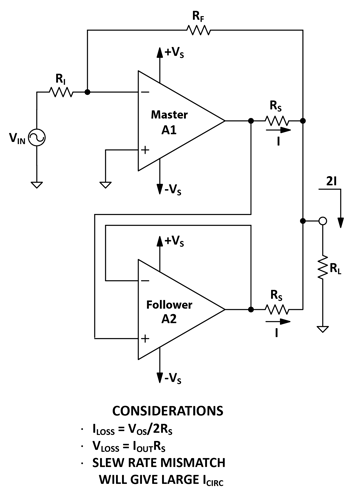
A parallel amplifier configuration combines multiple amplifier outputs to share load current. In this setup, two or more amplifiers drive the same load together, increasing the system’s overall current capability while maintaining roughly the same output voltage. Parallel operation is commonly used in applications where the load requires more current than a single amplifier channel can safely provide.
[](https://apexanalog.com/resources/appnotes/an26u.pdf)
*Figure 1: Example of a Parallel Amplifier Configuration*
This approach is especially useful for driving low-impedance or high-current loads such as motors, piezoelectric actuators, magnetic field control systems, and industrial equipment. Instead of pushing a single amplifier to its limits, the load current is distributed across multiple channels, helping improve thermal performance and overall system reliability.
Parallel configurations can also improve safe operating area (SOA) and reduce effective output impedance in some applications. However, successful parallel operation requires careful attention to current sharing. Small differences in gain, offset voltage, or thermal behavior can cause one amplifier to source more current than another. To improve balance and stability, designers often add small current sharing resistors at each output stage.
As power levels increase, PCB layout, thermal management, and compensation become increasingly important. Reactive or capacitive loads can introduce stability challenges, particularly at higher slew rates, making proper design practices critical for reliable operation. For a deeper technical discussion on parallel amplifier operation, refer to Apex Microtechnology Application Note AN26 on Parallel Configurations.
**Bridge Configurations**
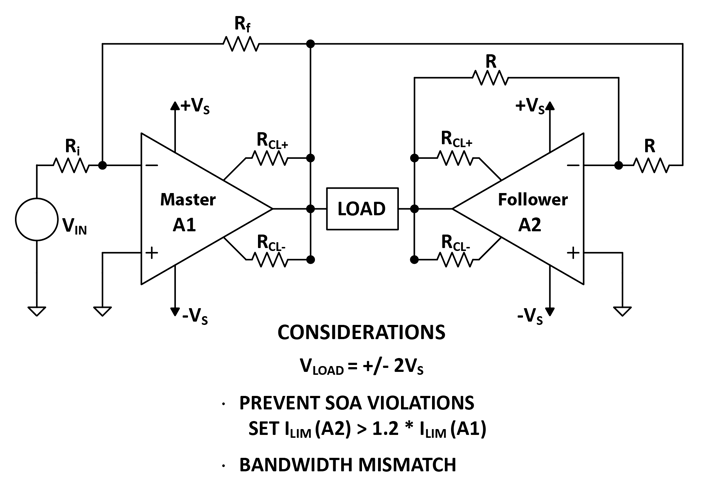
A bridge configuration uses two amplifier channels operating in opposite phase to drive a load differentially. Instead of one side of the load being connected to ground, both sides are actively driven by amplifier outputs.
[](https://apexanalog.com/resources/appnotes/an20u.pdf)
*Figure 2: Example of a Bridge Amplifier Configuration*
Because the load sees the voltage difference between the two outputs, the effective voltage across the load doubles compared to a single-ended design. Since output power is proportional to the square of voltage, bridge operation can significantly increase power delivery without requiring higher voltage supply rails.
Bridge configurations are commonly used when a system is voltage or slew-limited rather than current-limited. These configurations are widely found in audio amplifiers, piezo drivers, industrial actuation systems, and precision positioning equipment when greater output swing than a single amplifier can provide is necessary.
Beyond higher voltage swing, bridge operation can also improve dynamic performance in applications by effectively doubling slew rate across the load. Differential operation may also help reduce certain distortion components compared to single-ended designs. However, bridge systems still require careful compensation and channel matching to maintain stable operation, particularly when driving reactive loads or operating at higher power levels. For a more detailed explanation of bridge operation techniques, refer to Apex Microtechnology Application Note AN20 on Bridge Mode Operation of Power Operational Amplifiers.
**Choosing Between Parallel and Bridge Configurations**
Although both techniques increase overall power capability, they do so in very different ways. Parallel configurations increase output current capability, while bridge configurations increase voltage swing across the load.
| **Configuration** | **Primary Advantage** | **Best For** | **Main Tradeoff** |
| --- | --- | --- | --- |
| Parallel | Higher output current | Low-impedance loads | Current-sharing complexity |
| Bridge | Higher voltage swing | Higher output power | Requires differential drive |
In simple terms:
- Parallel configurations solve current limitations.
- Bridge configurations solve voltage limitations.
In many cases, this becomes the deciding factor when selecting a topology.
If the amplifier cannot supply enough current to the load, paralleling outputs is often the correct solution. This is common in low-impedance applications where current demand is extremely high. On the other hand, if the amplifier cannot generate sufficient voltage swing across the load, bridge operation is typically the better approach.
Some advanced systems combine both techniques in a parallel-bridge topology. These architectures allow engineers to achieve both higher current capability and greater voltage swing in the same system. They are commonly used in industrial power stages, high-power piezo applications, aerospace systems, and precision motion-control platforms. However, these architectures also introduce additional complexity in compensation, thermal management, gain matching, and PCB layout.
**Common Design Challenges**
Whether using parallel or bridge configurations, several practical considerations strongly influence long-term system performance and reliability. Thermal management becomes increasingly important as output power rises, requiring engineers to carefully evaluate junction temperature, heatsinking, airflow, and power dissipation across amplifier channels. Stability is another major concern, particularly when driving reactive or capacitive loads. In parallel systems, small mismatches in gain, offset voltage, or output impedance can lead to unequal current sharing, sometimes referred to as current hogging, which may increase thermal stress on individual devices.
PCB layout and compensation techniques also play a critical role in maintaining stable operation. Uneven routing, asymmetrical trace impedance, or poor channel matching can negatively impact current sharing, noise performance, EMI behavior, and overall stability. Bridge configurations similarly require close phase and bandwidth matching between channels to maintain balanced differential operation. In high-power analog systems, careful compensation, symmetrical layout practices, and conservative thermal design margins are often essential for achieving reliable long-term performance.
---
**Frequently Asked Questions**
Can bridge and parallel configurations be combined?
Yes. High-power systems sometimes use parallel-bridge topologies that combine increased current capability with higher voltage swing across the load.
Is bridge mode better for low-impedance loads?
Not necessarily. Low-impedance loads often require substantial current delivery, making parallel configurations more appropriate in many cases. Bridge mode is typically more beneficial when higher voltage swing is needed.
What happens if amplifier outputs are connected directly together?
Directly connecting amplifier outputs without proper balancing or compensation can lead to current hogging, instability, oscillation, or device damage. Parallel amplifier systems typically require current sharing resistors and careful compensation techniques to ensure stable current sharing.
What is the difference between a bridge and parallel amplifier configuration?
A parallel amplifier configuration increases output current capability by sharing load current across multiple amplifiers. A bridge configuration increases voltage swing across the load by driving it differentially with two amplifier channels operating in opposite phase.
Does bridge mode increase output power?
Yes. Because the voltage across the load is increased in bridge mode, total output power can increase significantly compared to a single-ended configuration.
What are the challenges of paralleling amplifiers?
Some common challenges include current hogging, thermal imbalance, oscillation, and stability issues caused by amplifier mismatches or reactive loads.
Why are current sharing resistors used in parallel amplifier circuits?
Current sharing resistors help improve current sharing between parallel amplifier outputs by reducing the effects of small gain or offset mismatches between channels.
---
**Conclusion**
Parallel and bridge configurations are both powerful techniques for extending amplifier performance, but they address different engineering challenges. Parallel configurations increase output current capability and are best suited for low-impedance or current-intensive loads. Bridge configurations increase voltage swing across the load and are ideal when higher output power is needed without increasing voltage supply rails.
The correct choice ultimately depends on understanding whether the application is fundamentally limited by current delivery or voltage swing. By carefully evaluating load requirements, thermal constraints, and system architecture, engineers can determine which topology provides the most efficient and reliable solution for their analog power design.
For more detailed technical information on these topologies, refer to our application notes below:
- [AN20 - Bridge Mode Operation of Power Operational Amplifiers](https://apexanalog.com/resources/appnotes/an20u.pdf)
- [AN26 - Parallel Configurations](https://apexanalog.com/resources/appnotes/an26u.pdf)
- Apex Microtechnology
Tags: [Analog Basics](https://blog.apexanalog.com/tag/analog-basics)
[Back to Blog](https://blog.apexanalog.com)
- [Tweet](https://twitter.com/share)
## Related Articles
## [Six Essential Op-Amp Configurations Every Engineer Should Know](https://blog.apexanalog.com/essential-op-amp-configurations)
This quick guide outlines their functions and equations. A must-know reference for every design...
[Read More](https://blog.apexanalog.com/essential-op-amp-configurations)
## [New High-Performance Operational Amplifiers for Space Applications](https://blog.apexanalog.com/rad-tol-product-expansion)
Apex Microtechnology expands their radiation tolerant product portfolio with new high-performance...
[Read More](https://blog.apexanalog.com/rad-tol-product-expansion)
## [Military Grade Power Management](https://blog.apexanalog.com/military-grade-power-management)
Apex Microtechnology offers industry-leading analog devices that maximize performance while...
[Read More](https://blog.apexanalog.com/military-grade-power-management)
##### Analog Tech Talk
#### Subscribe Now!
Register now to receive our monthly eNewsletter and expand your knowledge of power analog design — one topic at a time.

Apex Microtechnology (Apex) offers industry-leading power analog innovation for applications requiring high precision control of current, voltage and speed in the industrial, defense and aerospace, medical, and semiconductor capital equipment markets. The Apex product families include power operational amplifiers (linear amplifiers), PWM amplifiers (pulse width modulation, Class D amplifiers, switching amplifiers) and precision voltage references.
#### Company
- [About Apex](https://www.apexanalog.com/company/about.html)
- [Leadership](https://www.apexanalog.com/company/leadership.html)
- [Careers at Apex](https://www.apexanalog.com/company/careers.html)
- [Quality](https://www.apexanalog.com/quality/apex_certifications.html)
- [Sales and Distributors](https://www.apexanalog.com/company/apex_sales.html)
- [Suppliers](https://www.apexanalog.com/company/suppliers.html)
- [Contact](https://www.apexanalog.com/sales/contact_us.html)
- [Events](https://www.apexanalog.com/company/events.html)
- [Webmaster](https://www.apexanalog.com/company/webmaster.html)
- [SalesNet Login](https://apexanalog.sharepoint.com/sites/salesnet/SitePages/Home.aspx)
#### Literature
- [Data Book](https://cloud.3dissue.com/95932/96351/113449/Databook-Oct2015/index.html)
- [Product Selection Guide](https://www.apexanalog.com/resources/productbulletins/Product-Selection-Guide.pdf?__hstc=139971436.19e8af8d486e9d2b866a3feaa060a1e9.1639456649422.1639539452286.1639549981253.5&__hssc=139971436.1.1639549981253&__hsfp=2880844284)
- [Aerospace and Defense Solutions Guide](https://www.apexanalog.com/resources/productbulletins/Defense-and-Aerospace-Solutions-Guide.PDF?__hstc=139971436.19e8af8d486e9d2b866a3feaa060a1e9.1639456649422.1639539452286.1639549981253.5&__hssc=139971436.1.1639549981253&__hsfp=2880844284)
#### Support
- [Contact](https://www.apexanalog.com/sales/contact_us.html)
- [Application Note Library](https://www.apexanalog.com/support/app_note_library.html)
- [Technical Article Library](https://www.apexanalog.com/support/tech_article_library.html)
- [Spice Models](https://www.apexanalog.com/support/spice_models.html)
- [Lunch and Learn Technical Seminar](https://www.apexanalog.com/support/lunch_and_learn.html)
© 2026 Apex Microtechnology | [Privacy Policy](https://www.apexanalog.com/company/privacy_policy.html)