---
title: Why Doesn't My Amplifier Reach the Supply Rails?
description: Why doesn't your amplifier reach the supply rails? Learn what limits output voltage swing, how to read datasheet specs, and ways to reduce clipping.
image: https://blog.apexanalog.com/hubfs/Output-swing-Featured-Image-2.jpg
---
[](https://www.apexanalog.com/)
- [Home](https://www.apexanalog.com/)
- Products
- - POWER OPERATIONAL AMPLIFIERS
- [High Current Product Selector Matrix](https://www.apexanalog.com/products/matrix_high-current.html)
- [High Voltage Product Selector Matrix](https://www.apexanalog.com/products/matrix_high-voltage.html)
- [Product Selector Tables](https://www.apexanalog.com/products/linear_selector.html)
- PWM AMPLIFIERS
- [PWM Selector Matrix](https://www.apexanalog.com/products/matrix_pwm.html)
- [Product Selector Tables](https://www.apexanalog.com/products/pwm_selector.html)
- VOLTAGE REFERENCES
- [VRE Selector Matrix](https://www.apexanalog.com/products/matrix_vre.html)
- [VRE Over Temp Selector](https://www.apexanalog.com/products/vre_over-temperature.html)
- [Product Selector Tables](https://www.apexanalog.com/products/vre_selector.html)
- ACCESSORIES
- [Evaluation Kits](https://www.apexanalog.com/products/accessories.html#evaluationKits)
- [Heat Sinks](https://www.apexanalog.com/products/accessories.html#heatsinks)
- [Mating Sockets](https://www.apexanalog.com/products/accessories.html#matingSockets)
- [Thermal Washers](https://www.apexanalog.com/products/accessories.html#thermalWashers)
- [Applications](https://www.apexanalog.com/applications/applications_overview.html)
- [Overview](https://www.apexanalog.com/applications/applications_overview.html)
- [Defense/Aerospace](https://www.apexanalog.com/applications/defense-aerospace.html)
- [Industrial](https://www.apexanalog.com/applications/industrial.html)
- [Medical](https://www.apexanalog.com/applications/medical.html)
- [Semi-Cap](https://www.apexanalog.com/applications/semi-cap.html)
- [Digital Printing](https://www.apexanalog.com/applications/ink-jet-printer.html)
- Support
- [Contact Technical Support](https://www.apexanalog.com/support/technical_support.html)
- [Failure Analysis Request](https://www.apexanalog.com/support/failure_analysis_request.html)
- [Request Lunch and Learn](https://www.apexanalog.com/support/lunch_and_learn.html)
- Design Resources
- [Power Design Software Tool](https://www.apexanalog.com/support/power_design_tool.html)
- [Product Selection Guide](https://www.apexanalog.com/resources/productbulletins/Product-Selection-Guide.pdf?__hstc=139971436.19e8af8d486e9d2b866a3feaa060a1e9.1639456649422.1639456649422.1639456649422.1&__hssc=139971436.26.1639456649423&__hsfp=3512255926)
- [Aerospace/Defense Solutions Guide](https://www.apexanalog.com/resources/productbulletins/Defense-and-Aerospace-Solutions-Guide.PDF?__hstc=139971436.19e8af8d486e9d2b866a3feaa060a1e9.1639456649422.1639456649422.1639456649422.1&__hssc=139971436.26.1639456649423&__hsfp=3512255926)
- [Application Note Library](https://www.apexanalog.com/support/app_note_library.html)
- [Technical Seminar Library](https://www.apexanalog.com/support/tech_seminar_library.html)
- [Technical Article Library](https://www.apexanalog.com/support/tech_article_library.html)
- [Spice Models](https://www.apexanalog.com/support/spice_models.html)
- [Literature](https://www.apexanalog.com/support/literature.html)
- [Request a Lunch & Learn](https://www.apexanalog.com/support/lunch_and_learn.html)
- Sales
- [Contact Technical Support](https://www.apexanalog.com/support/technical_support.html)
- [Contact Sales/Customer Service](https://www.apexanalog.com/sales/contact_us.html)
- [Request a Quote](https://www.apexanalog.com/sales/quote_request.html)
- [Request a Sample](https://www.apexanalog.com/sales/sample_request.html)
- [Distributors and Sales Representatives](https://www.apexanalog.com/company/apex_sales.html)
- Quality
- [Apex Certifications](https://www.apexanalog.com/quality/apex_certifications.html)
- [Military Product Grades and Screening Program](https://www.apexanalog.com/quality/mil_product_grades_screening_program.html)
- [Product Marking](https://www.apexanalog.com/quality/product_marking.html)
- [Product Reliability Predictions](https://www.apexanalog.com/quality/product_reliability_predictions.html)
- [Product/Process Changes Notices (PCNs)](https://www.apexanalog.com/quality/product_change_notices.html)
- [Counterfeit Product Policy](https://www.apexanalog.com/quality/counterfeit_product_policy.html)
- [Date Code Policy](https://www.apexanalog.com/quality/date_code_policy.html)
- [Conflict Minerals](https://www.apexanalog.com/quality/conflict_materials.html)
- [Materials Database](https://www.apexanalog.com/quality/materials_database.html)
- [RoHS Compliance](https://www.apexanalog.com/quality/rohs_compliance.html)
- [REACH/SVHC](https://www.apexanalog.com/quality/reach_svhc.html)
- Company
- [Press Releases](https://www.apexanalog.com/company/press-releases.html)
- [Careers at Apex Microtechnology](https://www.apexanalog.com/company/careers.html)
- [Suppliers](https://www.apexanalog.com/company/suppliers.html)
- [Leadership](https://www.apexanalog.com/company/leadership.html)
- [About Apex Microtechnology](https://www.apexanalog.com/company/about.html)
- [Events](https://www.apexanalog.com/company/events.html)
- [Blog](https://blog.apexanalog.com/?__hstc=139971436.19e8af8d486e9d2b866a3feaa060a1e9.1639456649422.1639717738576.1639722129361.13&__hssc=139971436.5.1639722129361&__hsfp=3379298706)
-
-
-
-
- [Home](https://www.apexanalog.com/)
- Products
- - POWER OPERATIONAL AMPLIFIERS
- [High Current Product Selector Matrix](https://www.apexanalog.com/products/matrix_high-current.html)
- [High Voltage Product Selector Matrix](https://www.apexanalog.com/products/matrix_high-voltage.html)
- [Product Selector Tables](https://www.apexanalog.com/products/linear_selector.html)
- PWM AMPLIFIERS
- [PWM Selector Matrix](https://www.apexanalog.com/products/matrix_pwm.html)
- [Product Selector Tables](https://www.apexanalog.com/products/pwm_selector.html)
- VOLTAGE REFERENCES
- [VRE Selector Matrix](https://www.apexanalog.com/products/matrix_vre.html)
- [VRE Over Temp Selector](https://www.apexanalog.com/products/vre_over-temperature.html)
- [Product Selector Tables](https://www.apexanalog.com/products/vre_selector.html)
- ACCESSORIES
- [Evaluation Kits](https://www.apexanalog.com/products/accessories.html#evaluationKits)
- [Heat Sinks](https://www.apexanalog.com/products/accessories.html#heatsinks)
- [Mating Sockets](https://www.apexanalog.com/products/accessories.html#matingSockets)
- [Thermal Washers](https://www.apexanalog.com/products/accessories.html#thermalWashers)
- [Applications](https://www.apexanalog.com/applications/applications_overview.html)
- [Overview](https://www.apexanalog.com/applications/applications_overview.html)
- [Defense/Aerospace](https://www.apexanalog.com/applications/defense-aerospace.html)
- [Industrial](https://www.apexanalog.com/applications/industrial.html)
- [Medical](https://www.apexanalog.com/applications/medical.html)
- [Semi-Cap](https://www.apexanalog.com/applications/semi-cap.html)
- [Digital Printing](https://www.apexanalog.com/applications/ink-jet-printer.html)
- Support
- [Contact Technical Support](https://www.apexanalog.com/support/technical_support.html)
- [Failure Analysis Request](https://www.apexanalog.com/support/failure_analysis_request.html)
- [Request Lunch and Learn](https://www.apexanalog.com/support/lunch_and_learn.html)
- Design Resources
- [Power Design Software Tool](https://www.apexanalog.com/support/power_design_tool.html)
- [Product Selection Guide](https://www.apexanalog.com/resources/productbulletins/Product-Selection-Guide.pdf?__hstc=139971436.19e8af8d486e9d2b866a3feaa060a1e9.1639456649422.1639456649422.1639456649422.1&__hssc=139971436.26.1639456649423&__hsfp=3512255926)
- [Aerospace/Defense Solutions Guide](https://www.apexanalog.com/resources/productbulletins/Defense-and-Aerospace-Solutions-Guide.PDF?__hstc=139971436.19e8af8d486e9d2b866a3feaa060a1e9.1639456649422.1639456649422.1639456649422.1&__hssc=139971436.26.1639456649423&__hsfp=3512255926)
- [Application Note Library](https://www.apexanalog.com/support/app_note_library.html)
- [Technical Seminar Library](https://www.apexanalog.com/support/tech_seminar_library.html)
- [Technical Article Library](https://www.apexanalog.com/support/tech_article_library.html)
- [Spice Models](https://www.apexanalog.com/support/spice_models.html)
- [Literature](https://www.apexanalog.com/support/literature.html)
- [Request a Lunch & Learn](https://www.apexanalog.com/support/lunch_and_learn.html)
- Sales
- [Contact Technical Support](https://www.apexanalog.com/support/technical_support.html)
- [Contact Sales/Customer Service](https://www.apexanalog.com/sales/contact_us.html)
- [Request a Quote](https://www.apexanalog.com/sales/quote_request.html)
- [Request a Sample](https://www.apexanalog.com/sales/sample_request.html)
- [Distributors and Sales Representatives](https://www.apexanalog.com/company/apex_sales.html)
- Quality
- [Apex Certifications](https://www.apexanalog.com/quality/apex_certifications.html)
- [Military Product Grades and Screening Program](https://www.apexanalog.com/quality/mil_product_grades_screening_program.html)
- [Product Marking](https://www.apexanalog.com/quality/product_marking.html)
- [Product Reliability Predictions](https://www.apexanalog.com/quality/product_reliability_predictions.html)
- [Product/Process Changes Notices (PCNs)](https://www.apexanalog.com/quality/product_change_notices.html)
- [Counterfeit Product Policy](https://www.apexanalog.com/quality/counterfeit_product_policy.html)
- [Date Code Policy](https://www.apexanalog.com/quality/date_code_policy.html)
- [Conflict Minerals](https://www.apexanalog.com/quality/conflict_materials.html)
- [Materials Database](https://www.apexanalog.com/quality/materials_database.html)
- [RoHS Compliance](https://www.apexanalog.com/quality/rohs_compliance.html)
- [REACH/SVHC](https://www.apexanalog.com/quality/reach_svhc.html)
- Company
- [Press Releases](https://www.apexanalog.com/company/press-releases.html)
- [Careers at Apex Microtechnology](https://www.apexanalog.com/company/careers.html)
- [Suppliers](https://www.apexanalog.com/company/suppliers.html)
- [Leadership](https://www.apexanalog.com/company/leadership.html)
- [About Apex Microtechnology](https://www.apexanalog.com/company/about.html)
- [Events](https://www.apexanalog.com/company/events.html)
- [Blog](https://blog.apexanalog.com/?__hstc=139971436.19e8af8d486e9d2b866a3feaa060a1e9.1639456649422.1639717738576.1639722129361.13&__hssc=139971436.5.1639722129361&__hsfp=3379298706)
# Why Doesn't My Amplifier Reach the Supply Rails?
Published by [Apex Microtechnology](https://blog.apexanalog.com/author/apex-microtechnology) on Jul 31, 2026, 12:04:05 PM
Learn why operational amplifiers (op-amps) can't always reach the supply rails and how output voltage swing affects device performance. This guide explains what limits output voltage swing, how to evaluate amplifier datasheet specifications, and practical design techniques to reduce clipping using the Apex PA52 power op-amp as a real world example.
When designing an analog circuit, it's easy to assume that an amplifier powered from ±80 V supplies should be capable of producing an output that swings from +80 V to -80 V. While this seems intuitive, it is not how real op-amps behave. Even when operating well within their specified supply voltage range, most amplifiers will reach their output limit before the output voltage reaches either supply rail.
This behavior is a normal characteristic of amplifier operation and is described by the amplifier's output voltage swing specification. While the supply rails establish the amplifier's operating limits, output voltage swing defines how much of that range is actually usable. Understanding what limits output voltage swing, how to evaluate it in a datasheet, and how to design around those limitations helps engineers avoid unexpected clipping at the output and allows them to select the appropriate amplifier for their application.
For this article, we'll use [Apex Microtechnology's PA52 high-voltage power operational amplifier](https://apexanalog.com/products/pa52.html) as a practical example to demonstrate how output voltage swing is specified and how engineers can evaluate it during the design process.
**What is Output Voltage Swing?**
Output voltage swing is the maximum positive and negative output voltage an amplifier can produce while maintaining linear operation. Rather than being equal to the supply voltage, the available output is limited by the amplifier's internal design and the conditions under which it operates. For the [PA52](https://www.apexanalog.com/products/pa52.html), output voltage swing is specified under defined operating conditions within the datasheet rather than as a single fixed value. This is because the maximum achievable output voltage depends on factors such as output current, amplifier configuration, and supply voltage. As these operating conditions change, so does the amount of voltage the amplifier can deliver to the load.
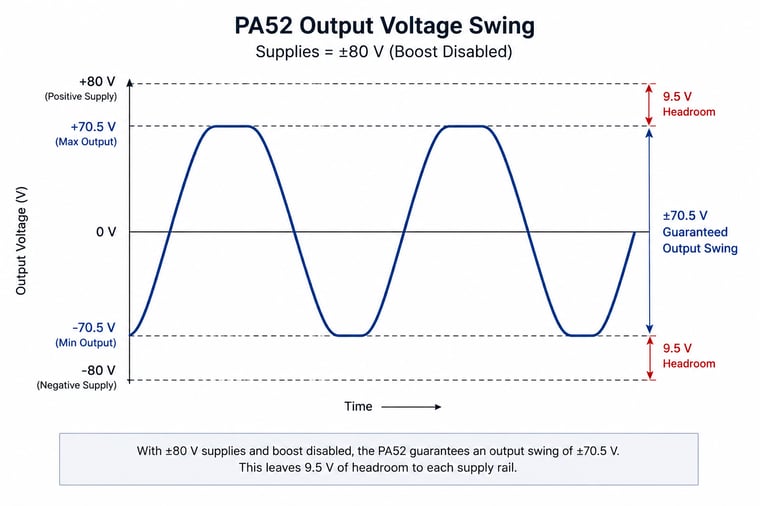
*Figure 1: Illustration of output voltage swing using the PA52 powered from ±80 V supplies.*
**What Limits Output Voltage Swing?**
Output voltage swing is determined by the voltage headroom required by the amplifier's output stage. Every op-amp contains output devices that must maintain a finite voltage across them in order to remain in their active operating region. As the output voltage approaches either supply rail, less voltage is available across these devices until they can no longer regulate the output linearly. At this point, the amplifier saturates and the output begins to clip.
Although this behavior is often described simply as "output stage headroom," the required voltage is the sum of several internal voltage drops. The largest contributor is typically the voltage drop across the output devices themselves, which increases as output current increases. Additional voltage is required by the amplifier's internal bias circuitry and driver stages. Together, these voltage drops determine how closely the output can approach the supply rails.
A simplified way to visualize this relationship is:
*Output Headroom ≈ (RDS(on) of Output Device × Output Current) + Internal Voltage Drops*
While this equation is simplified and does not represent the complete amplifier model, it provides useful intuition for understanding why output voltage swing decreases as output current increases. As more current flows through the output stage, the voltage dropped across the output devices increases. The remaining voltage drops required by the amplifier's internal circuitry add to this value, producing the total output headroom specified in the datasheet. This relationship also explains why output voltage swing varies from one amplifier to another. Different output stage architectures, protection circuitry, and components all influence the total internal voltage drop required for proper operation.
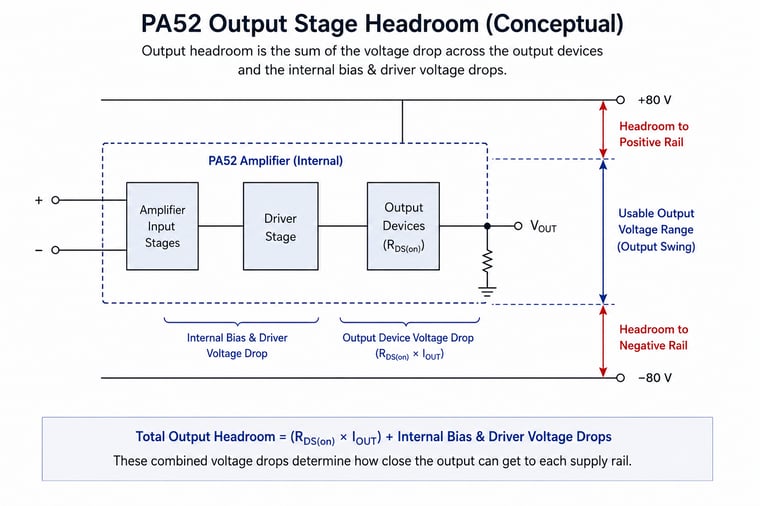
*Figure 2: Conceptual diagram showing the amplifier output stage. Illustrates the output headroom as the sum of the voltage drop across the output devices (RDS(on) × IOUT) plus the internal bias and driver voltage drops*
**How Do You Evaluate Output Voltage Swing Using a Datasheet**
Understanding the concept of output voltage swing is only the first step. Engineers must also determine whether an amplifier can achieve the output voltage required by their application. Fortunately, this information is provided directly within Apex’s datasheets. Using the PA52 as an example, the evaluation process can be broken into four simple steps.
Step 1: Locate the Output Voltage Swing Specification
Begin by locating the Electrical Characteristics table within the datasheet. Under the Output section, the PA52 specifies a minimum output voltage swing together with the operating conditions used during characterization.
For example, the datasheet specifies a **minimum output voltage swing of ±VS − 9.5 V** while delivering **40 A** of output current. A second specification is provided when the amplifier's boost supply is used, reducing the required output headroom to **±VS − 5.8 V**.
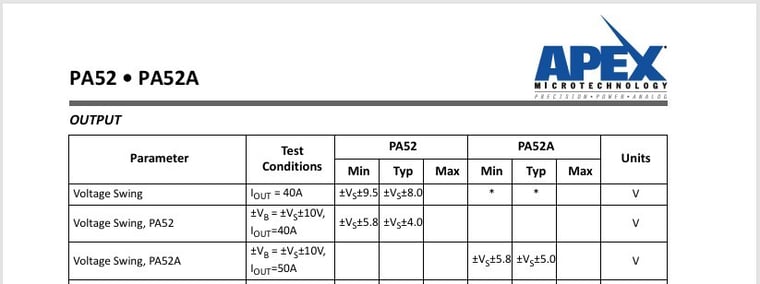
*Figure 3: Screenshot from the PA52 datasheet showing the Output Voltage Swing specifications.*
Step 2: Review the Test Conditions
Output voltage swing should never be evaluated independently of the accompanying test conditions. The specified output voltage is guaranteed only under the operating conditions listed within the datasheet.
For the PA52, the specification is measured while delivering 40 A of output current. Because output current directly influences the voltage drop across the output stage, this operating condition is just as important as the output voltage itself. Supply voltage, boost supply configuration, and operating temperature should also be considered when comparing datasheet specifications to an actual application.
Step 3: Compare the Specification to Your Application
Suppose the application powers the PA52 from ±80 V supplies without using the boost supply. The datasheet specifies a minimum output swing of ±VS − 9.5 V.
Therefore:
Maximum Positive Output = +80 V − 9.5 V = +70.5 V
Maximum Negative Output = −80 V + 9.5 V = −70.5 V
If the application requires an output swing of only ±60 V, the PA52 provides adequate design margin. However, if the application requires ±75 V while delivering 40 A, the amplifier would not be guaranteed to achieve that output under the specified operating conditions. Evaluating this relationship early in the design process helps prevent unexpected clipping during system testing.
Step 4: Leave Design Margin
Although an amplifier may satisfy the minimum datasheet specification, designing at the abs. max limit leaves little room for component tolerances, temperature variation, supply fluctuations and changing load conditions. Whenever possible, leave additional voltage margin between the application's required output voltage and the amplifier's guaranteed output voltage swing. This simple design practice improves amplifier robustness and reduces the likelihood of unexpected clipping during worst-case operating conditions.
**Designing Around Output Voltage Swing Limitations**
Once output voltage swing has been evaluated, the next question becomes how to compensate when the available output range is insufficient. Depending on the application, several design approaches can increase the available output voltage or reduce the likelihood of clipping.
Increase the Supply Voltage
If the amplifier's operating limits allow, increasing the supply voltage increases the available output range while maintaining approximately the same headroom. For example, an amplifier requiring 9.5 V of output headroom will have more usable output voltage when operating from ±90 V supplies than from ±80 V supplies.
Reduce the Required Output Current
Since the voltage drop across the output devices increases with output current, reducing the current delivered to the load also reduces the required output headroom. Increasing the load impedance, reducing the required output current, or selecting an operating point that demands less output current allows the amplifier to operate closer to the supply rails. This relationship is one of the primary reasons output voltage swing specifications are always accompanied by defined load conditions within the datasheet.
Utilize the PA52 Boost Supply
One feature unique to the PA52 is its dedicated boost supply, which powers portions of the output stage independently of the primary supply rails. By reducing the voltage headroom required within the output stage, the PA52's guaranteed output voltage swing increases from ±70.5 V to ±74.2 V (using ±80 V supplies under the specified test conditions).
In the previous section, we calculated that the PA52 is guaranteed to swing to ±70.5 V when operating from ±80 V supplies with the boost supply disabled. For many applications, this output range provides ample margin. However, designs operating near the amplifier's output limits may begin to experience clipping because the required signal exceeds the available output swing.
Enabling the boost supply reduces the required output headroom from 9.5 V to 5.8 V, allowing the amplifier to swing significantly closer to the supply rails without increasing the primary supply voltage. As illustrated in Figure 5, this additional output range can eliminate clipping by providing enough voltage swing for the amplifier to accurately reproduce the required signal. Rather than changing the application or increasing the supply voltage, the boost supply effectively recovers additional usable output range by reducing the internal voltage drop within the output stage.
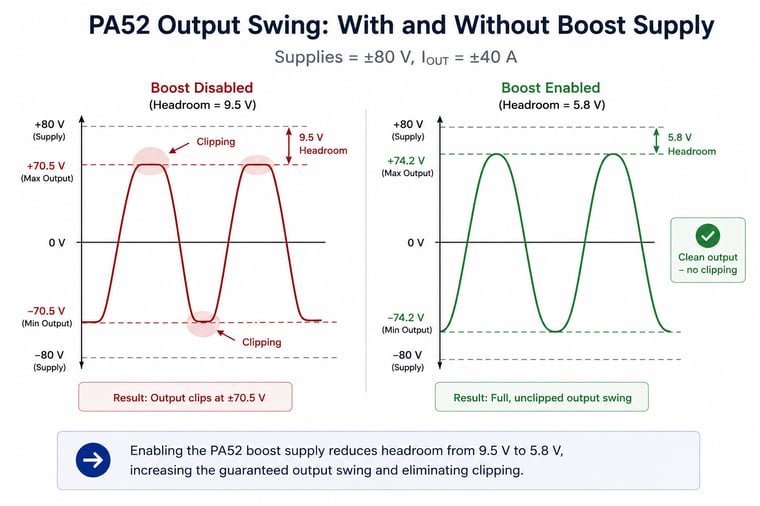
*Figure 4: Comparison of the PA52 output swing with and without the boost supply enabled operating at 80V supply*
**Designing Around Output Voltage Swing Limitations**
**When evaluating output voltage swing, follow these four steps:**
✓ Locate the output voltage swing specification.
✓ Review the associated test conditions.
✓ Compare the guaranteed output swing to your application's required output voltage.
✓ Leave adequate design margin for worst-case operating conditions.
Conclusion
Safe An amplifier's supply rails establish its operating limits, but they do not define the maximum voltage that can be delivered to the load. That responsibility belongs to the output voltage swing specification, which accounts for the voltage headroom required by the amplifier's output stage under defined operating conditions. By understanding what creates output headroom, learning how to evaluate output voltage swing in the datasheet, and designing with adequate voltage margin, engineers can avoid unexpected clipping and build more reliable analog systems.
For more resources on increasing output swing, refer to our application notes below:
- [AN48 - Increasing Output Swing in Power Operational Amplifier](https://apexanalog.com/resources/appnotes/an48u.pdf)
- [AN52 - High Voltage Current Buffer](https://apexanalog.com/resources/appnotes/an52u.pdf)
\- Apex Microtechnology
---
**Frequently Asked Questions About Output Voltage Swing (FAQ)**
Why doesn't my amplifier reach the supply rails?
Most operational amplifiers require voltage headroom across their output stage to maintain linear operation. As the output approaches either supply rail, the output devices eventually run out of available voltage and can no longer accurately reproduce the input signal. The result is output saturation or clipping before the output reaches the supply rails. This behavior is normal and is defined by the amplifier's output voltage swing specification.
What is output voltage swing?
Output voltage swing is the maximum positive and negative voltage an amplifier can produce while remaining in its linear operating region. It represents the usable output range of the amplifier and is typically specified in the datasheet under defined operating conditions such as supply voltage, output current, load resistance, and temperature.
Why does output voltage swing decrease as output current increases?
As output current increases, more voltage is dropped across the amplifier's output devices. This voltage drop is approximately proportional to the output current and the effective on-resistance of the output stage. Higher output current therefore increases the required output headroom, reducing the maximum voltage the amplifier can deliver to the load.
Can increasing the supply voltage eliminate clipping?
Increasing the supply voltage increases the available output range, provided the amplifier remains within its operating limits. However, the amplifier still requires output headroom, so the output will not typically reach the supply rails. Increasing the supply voltage simply provides more usable output voltage after accounting for the required headroom.
How can I reduce clipping without increasing the supply voltage?
Several design techniques can reduce clipping, including lowering the required output current, increasing load impedance, selecting an amplifier with lower output headroom, or using amplifier features that extend the available output swing. For example, the PA52's dedicated boost supply reduces the required output headroom, allowing the amplifier to swing closer to the supply rails without increasing the primary supply voltage.
---
**Device Featured in This Blog Article**
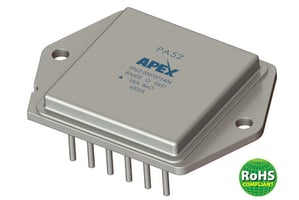
[PA52 - 40A Power Amplifier with High Internal Power Dissipations](https://www.apexanalog.com/products/pa52.html)
[](https://www.apexanalog.com/products/pa52.html)
- Supply Voltage - 200V, 230V w/ boost voltage
- High Internal Dissipation - 400W
- High Output Current - 40A Continuous, 80A PEAK
- High Slew Rate – 50V/µs
- Optional boost voltage inputs
[**REQUEST A SAMPLE**](https://apexanalog.com/sales/sample_request.html)
The PA52 is a 40A (80A PEAK), 200V power operational amplifier featuring 90kHz of power bandwidth and a 50V/µs slew rate. With this combination of high current output, bandwidth, slew rate, and 400 watts of internal power dissipation, the PA52 is targeted for applications in the semi-cap equipment market.
Tags: [Analog Basics](https://blog.apexanalog.com/tag/analog-basics)
[Back to Blog](https://blog.apexanalog.com)
- [Tweet](https://twitter.com/share)
## Related Articles
## [Five Common Op-Amp Problems and How to Fix Them](https://blog.apexanalog.com/five-common-op-amp-problems)
Learn what causes five common op-amp problems, including output clipping, oscillation, overheating,...
[Read More](https://blog.apexanalog.com/five-common-op-amp-problems)
## [Safe Operating Area (SOA): How to Read SOA Curves and Improve Amplifier Reliability](https://blog.apexanalog.com/safe-operating-area-soa)
Safe Operating Area (SOA) is one of the most important, yet frequently misunderstood specifications...
[Read More](https://blog.apexanalog.com/safe-operating-area-soa)
## [High Reliability Products and the Difference Between "M" and "M/883"](https://blog.apexanalog.com/high-reliability)
High Reliability Products
[Read More](https://blog.apexanalog.com/high-reliability)
##### Analog Tech Talk
#### Subscribe Now!
Register now to receive our monthly eNewsletter and expand your knowledge of power analog design — one topic at a time.

Apex Microtechnology (Apex) offers industry-leading power analog innovation for applications requiring high precision control of current, voltage and speed in the industrial, defense and aerospace, medical, and semiconductor capital equipment markets. The Apex product families include power operational amplifiers (linear amplifiers), PWM amplifiers (pulse width modulation, Class D amplifiers, switching amplifiers) and precision voltage references.
#### Company
- [About Apex](https://www.apexanalog.com/company/about.html)
- [Leadership](https://www.apexanalog.com/company/leadership.html)
- [Careers at Apex](https://www.apexanalog.com/company/careers.html)
- [Quality](https://www.apexanalog.com/quality/apex_certifications.html)
- [Sales and Distributors](https://www.apexanalog.com/company/apex_sales.html)
- [Suppliers](https://www.apexanalog.com/company/suppliers.html)
- [Contact](https://www.apexanalog.com/sales/contact_us.html)
- [Events](https://www.apexanalog.com/company/events.html)
- [Webmaster](https://www.apexanalog.com/company/webmaster.html)
- [SalesNet Login](https://apexanalog.sharepoint.com/sites/salesnet/SitePages/Home.aspx)
#### Literature
- [Data Book](https://cloud.3dissue.com/95932/96351/113449/Databook-Oct2015/index.html)
- [Product Selection Guide](https://www.apexanalog.com/resources/productbulletins/Product-Selection-Guide.pdf?__hstc=139971436.19e8af8d486e9d2b866a3feaa060a1e9.1639456649422.1639539452286.1639549981253.5&__hssc=139971436.1.1639549981253&__hsfp=2880844284)
- [Aerospace and Defense Solutions Guide](https://www.apexanalog.com/resources/productbulletins/Defense-and-Aerospace-Solutions-Guide.PDF?__hstc=139971436.19e8af8d486e9d2b866a3feaa060a1e9.1639456649422.1639539452286.1639549981253.5&__hssc=139971436.1.1639549981253&__hsfp=2880844284)
#### Support
- [Contact](https://www.apexanalog.com/sales/contact_us.html)
- [Application Note Library](https://www.apexanalog.com/support/app_note_library.html)
- [Technical Article Library](https://www.apexanalog.com/support/tech_article_library.html)
- [Spice Models](https://www.apexanalog.com/support/spice_models.html)
- [Lunch and Learn Technical Seminar](https://www.apexanalog.com/support/lunch_and_learn.html)
© 2026 Apex Microtechnology | [Privacy Policy](https://www.apexanalog.com/company/privacy_policy.html)